Best Number Puzzles for Improving Logical Reasoning
The human brain thrives on friction. In an era dominated by algorithmic recommendations, spellcheckers, automated navigation systems, and instant digital lookups, everyday life requires fewer mental calculations and deductive steps than ever before. While this technological convenience saves physical time, it can leave critical reasoning skills underutilized. Just as physical muscles undergo atrophy when deprived of regular resistance, cognitive faculties require deliberate, structured tension to stay agile, sharp, and resilient.
Number puzzles serve as an ideal mental gym. Despite their numerical appearance, these challenges are rarely about complex mathematical arithmetic. Instead, numbers act as clean, universally understood symbolic placeholders governed by rigid rules of relation, placement, and deduction. Engaging with well-crafted number puzzles trains the prefrontal cortex, refines working memory, cultivates patience, and strengthens the ability to identify subtle patterns under constraints. Exploring the finest logic-based number puzzles reveals how each variation targets distinct cognitive pathways to elevate your daily problem-solving toolkit.
The Cognitive Architecture of Number Puzzles
Solving a logic puzzle is not a passive pastime; it is an active exercise in deductive reasoning, constraint satisfaction, and systematic elimination. When tackling a grid-based numerical dilemma, the brain engages multiple executive functions simultaneously.
-
Deductive Deduction: The capacity to move methodically from a broad set of premises to a guaranteed logical truth. When rules dictate that a digit can only exist in one precise location, finding that space eliminates ambiguity.
-
Working Memory Maintenance: Holding multiple competing variables, provisional candidates, and positional rules in your mind while testing the validity of a prospective move.
-
Pattern Recognition and Heuristics: Learning to spot structural clusters, recurring digit behaviors, and spatial symmetries that shorten problem-solving trajectories over time.
-
Inhibitory Control and Emotional Regulation: Resisting the urge to guess impulsively when stuck. High-level puzzles penalize random choices, teaching solvers to pause, reassess their foundational assumptions, and remain composed through complexity.
By isolating these mental processes, number puzzles provide immediate feedback loops. A single error eventually produces an irreconcilable contradiction, showing you exactly where your logical chain broke down.
Sudoku: The Foundational Benchmark of Pure Elimination
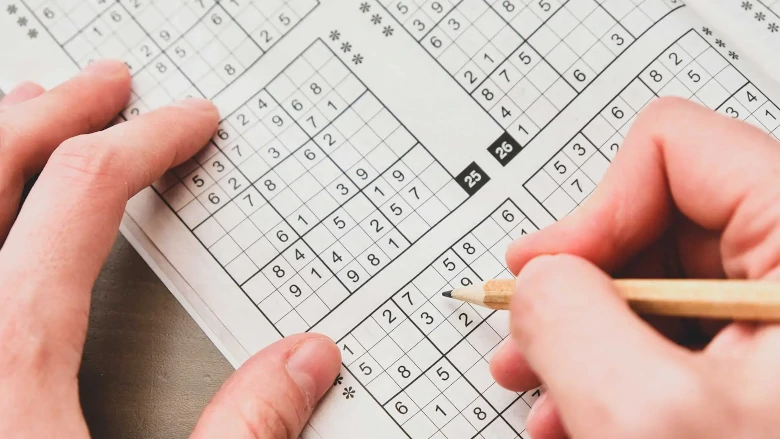
Sudoku remains the undisputed global standard of modern logic puzzles. Originating from eighteenth-century mathematical concepts and popularized in late twentieth-century Japan, Sudoku operates on a straightforward nine-by-nine grid divided into nine individual three-by-three subgrids. The rule is deceptively simple: fill every row, column, and subgrid with the digits one through nine without repeating a number.
The brilliance of Sudoku lies in its complete separation from arithmetic. You never add, subtract, multiply, or divide the numbers. You could replace the digits with letters, geometric shapes, or distinct colors, and the puzzle would function identically.
Sudoku builds analytical rigor through progressive deductive strategies:
-
Naked and Hidden Singles: The basic technique of identifying when eight other digits already populate a given row, column, or block, leaving only one possible numerical candidate for the empty cell.
-
Locked Candidates and Pointing Pairs: Recognizing that when a digit is confined to a single row or column within a specific subgrid, it can be eliminated as a possibility from that entire line in neighboring boxes.
-
Advanced Elimination Chaining: Navigating intricate structural formations like X-Wings, Swordfish, and XY-Chains, which demand tracing long chains of conditional logic across multiple quadrants to eliminate candidates elsewhere on the board.
Practicing Sudoku trains you to look past surface noise, teaching your mind to scan complex layouts methodically and spot indirect relationships that lie beneath plain sight.
KenKen: Marrying Spatial Deduction with Basic Arithmetic
For those who want spatial placement paired with mental arithmetic, KenKen delivers an exceptional mental workout. Created in Japan by an educator who wanted to make math instruction engaging, KenKen uses variable grid dimensions ranging from simple three-by-three squares to demanding nine-by-nine arrangements.
The grid is divided into heavily outlined clusters of cells called cages. Each cage features a target number and an arithmetic operation symbol: addition, subtraction, multiplication, or division. Your goal is to fill the grid so that each row and column contains no duplicate digits, while the numbers inside each cage produce the target outcome when using the designated operation.
KenKen exercises cognitive muscles that pure elimination puzzles miss:
-
Combinatorial Factoring: If a three-cell cage with a multiplication symbol requires a product of twenty-four, your brain must rapidly calculate and evaluate all valid three-digit factoring sets that fit within the grid limits.
-
Constraint Intersection: Merging basic math calculations with standard row and column exclusion rules, forcing the mind to pivot smoothly between numerical computation and spatial geometry.
-
Cross-Disciplinary Thinking: Bridging quantitative calculation and qualitative deduction, KenKen promotes cognitive agility by preventing your thoughts from locking into a single problem-solving mode.
Kakuro: The Mathematical Crossword Dilemma
Often described as a cross-sums puzzle, Kakuro resembles a traditional black-and-white crossword puzzle where letters are replaced by digits and word clues are substituted with numerical sums. Solvers must fill consecutive horizontal and vertical runs of white cells using only the digits one through nine. The sum of the digits in each run must match the clue printed above or to the left of the run, with one vital catch: no digit can be repeated within any individual sum.
Kakuro is one of the finest tools for cultivating combinatorial intuition and numerical precision:
-
Unique Sum Permutations: Veteran solvers quickly memorize critical unique combinations. For example, a sum of sixteen across two cells can only be composed of seven and nine, while a sum of twenty-four across three cells must contain seven, eight, and nine.
-
Positional Intersections: The core logic of Kakuro occurs where horizontal and vertical sum runs intersect. If a horizontal run requires an odd digit and the crossing vertical run only accommodates even numbers, that intersection point is solved instantly.
-
Partition Analysis: Breaking down target sums into allowable numerical partitions under strict length and space limits exercises flexible working memory and rapid mathematical decomposition.
The rhythmic nature of Kakuro trains the mind to handle multi-tiered boundary problems, making it a favorite among software engineers, mathematicians, and logistical planners.
Nonograms: Transforming Numerical Clues into Visual Logic
Also widely known as Picross or Japanese Picture Logic, Nonograms bridge the gap between numerical sequence deduction and visual pattern assembly. A Nonogram presents an empty rectangular grid with series of numbers listed outside the boundaries of every row and column.
These numbers indicate the lengths and order of unbroken blocks of filled cells in that line. For instance, a clue of four, two, and one means there is a continuous group of four filled cells, followed by at least one empty space, then two filled cells, at least one space, and finally a single filled cell. The ultimate reward of a solved Nonogram is a recognizable pixel-art image revealed by your deductions.
The cognitive benefits of Nonograms are distinct:
-
Spatial Overlap Calculation: If a row of ten cells contains an unbroken block of seven filled squares, mathematical overlap dictates that the middle four cells must be shaded, regardless of whether the block sits on the far left, far right, or in the center.
-
Dual-State Tracking: Solvers must actively track both confirmed filled spaces and verified empty spaces, typically marking confirmed blanks with small crosses to construct boundaries for future calculations.
-
Visual Synthesis: Connecting linear numerical clues into cohesive spatial shapes encourages communication between the analytical left hemisphere and the spatial right hemisphere of the brain.
Nonograms build deep spatial awareness, making them superb training for architects, design professionals, and anyone seeking to strengthen abstract visual reasoning.
Str8ts: Compartmentalized Sequential Logic
Str8ts is a modern number puzzle that blends elements of Sudoku with traditional poker straight mechanics. Played on a nine-by-nine grid, the board contains both white cells and black cells. Some black cells contain fixed numbers, which serve as dividers, while white cells must be populated with digits.
The objective is to fill the white cells so that no digit from one through nine repeats in any row or column. More importantly, every contiguously connected compartment of white cells in a row or column must form a straight, a set of consecutive numbers in any spatial order, such as four, five, six, and seven, without gaps.
Str8ts demands unique logical pathways:
-
Set Boundaries and Range Restriction: If a compartment contains four white cells, the lowest number that can appear in that run is one and the highest is six. A digit like nine is immediately disqualified because you cannot build a four-digit straight that contains it without exceeding the nine-digit ceiling.
-
Black Cell Integration: Determining whether a black cell with an anchor digit influences the available numerical pool for adjacent white straights adds an extra layer of structural planning.
-
Dynamic Range Evaluation: Constantly recalculating maximum and minimum allowable boundaries for isolated pockets builds mental resilience against rigid thinking.
How to Integrate Number Puzzles into a Sustainable Mental Routine
Dedicating hours at a desk with an eraser is not required to reap the cognitive rewards of logic puzzles. Consistency and focused attention matter far more than total time spent.
To turn number puzzles into an effective cognitive training habit:
-
Prioritize Method Over Speed: When beginning, ignore stopwatches and timers. Rushing encourages hasty assumptions and guesswork. Focus entirely on constructing ironclad logical proofs for every digit you write down.
-
Avoid Trial-and-Error Guessing: If you find yourself guessing a number to see where it leads, stop. Every well-constructed logic puzzle has a deterministic, step-by-step path that never requires blind luck. Step back, re-verify empty cell candidates, and search for the missing logical rule.
-
Vary Puzzle Formats Regularly: Do not stick exclusively to standard Sudoku for years. Once your brain internalizes the heuristics of one puzzle type, the cognitive challenge begins to diminish. Rotating between Sudoku, KenKen, Kakuro, and Nonograms forces your neural pathways to continuously adapt to unfamiliar rules and spatial layouts.
Frequently Asked Questions
Are strong math skills required to enjoy and solve number puzzles?
No, advanced mathematics is entirely unnecessary for the vast majority of number puzzles. Puzzles like Sudoku, Nonograms, and Str8ts use numbers strictly as symbolic markers for location, sequence, and elimination, requiring zero arithmetic. While puzzles like KenKen and Kakuro do involve basic addition, subtraction, multiplication, and division, the required math is elementary school arithmetic. The true challenge lies in the spatial logic and process of deduction rather than advanced calculation.
How do number puzzles differ from language-based word puzzles like crosswords?
Word puzzles and crosswords rely heavily on crystallized intelligence, which is the stored repository of vocabulary, trivia, cultural knowledge, and language history accumulated throughout your life. If you do not know a specific trivia fact, you may be permanently blocked. Number puzzles rely almost entirely on fluid intelligence, which is the innate capacity to think abstractly, identify relationships, analyze patterns, and solve novel problems using immediate, closed-system logic without relying on external trivia.
Can regular practice with number puzzles protect against cognitive decline?
Engaging with mentally demanding activities like number puzzles contributes to cognitive reserve, the brain resilience against neuropathological damage and age-related decline. While puzzles alone cannot guarantee the prevention of neurodegenerative diseases, regularly stimulating your prefrontal cortex with logic problems promotes neuroplasticity, preserves working memory speed, and supports executive mental functioning into advanced age.
What should a solver do when completely stuck on a difficult number puzzle?
When facing a mental block, avoid making blind guesses. Step away from the puzzle for fifteen to thirty minutes; the subconscious mind continues to process spatial arrangements in the background, often allowing you to spot an obvious pattern upon returning. If you remain stuck, switch to an active audit: verify every row, column, and subgrid for subtle candidate omissions, or look for intersections where two separate elimination rules overlap to restrict a cell.
Is it better to solve number puzzles on physical paper or digital mobile applications?
Both mediums offer distinct advantages. Physical paper puzzles demand sustained attention, eliminate digital notification distractions, and improve tactile memory retention through handwriting. Digital apps, however, streamline candidate tracking with pencil mark tools, instantly highlight accidental duplicate entries, and offer nearly infinite puzzle catalogs across varying difficulty tiers. The ideal choice depends on personal preference, provided you turn off automatic hint features that do the deductive reasoning for you.
Why is guessing considered a counterproductive strategy in logic puzzles?
Guessing undermines the primary cognitive benefit of logic puzzles: training rigorous deduction and cause-and-effect reasoning. When you guess a digit, you bifurcate the puzzle into hypothetical branches that become messy to undo when an error surfaces down the line. Finding the single valid logical reason why a digit belongs in a cell trains discipline, patience, and absolute confidence in your problem-solving conclusions.
What is the difference between a symmetrical Sudoku puzzle and an asymmetrical puzzle?
Symmetry in Sudoku refers to the spatial layout of the initial pre-filled clues. In a rotationally symmetric puzzle, rotating the grid one hundred and eighty degrees reveals that the starting clue cells occupy identical mirrored positions across the board. While symmetry has no effect on the underlying logic required to solve the puzzle, it is considered a mark of refined craftsmanship and artistic elegance in human-designed puzzle construction.